
Review · FRANCE
From Sarlat-la-Canéda: Lascaux IV and Cave Art Full-Day Tour
The strongest part of this day is the contrast between real prehistoric spaces and Lascaux IV’s astonishing reproduction. At Rouffignac, you enter an authentic cave, while at Lascaux IV you see paintings recreated with remarkable care, including animals painted with natural pigments. The National Prehistory Museum at Les Eyzies gives the whole subject a useful human and scientific frame.
I like the small van group, limited to eight people, and the way the guide joins the dots between caves, geology, Cro-Magnon discoveries, and the Dordogne countryside. I also like that the guide handles the driving and timed admissions, which would be awkward to coordinate by car in one day. The main caution is that it is a long, tightly arranged day, and English tours inside Lascaux IV are limited. You may receive the cave explanation from your guide before and after the visit instead.
Key points at a glance
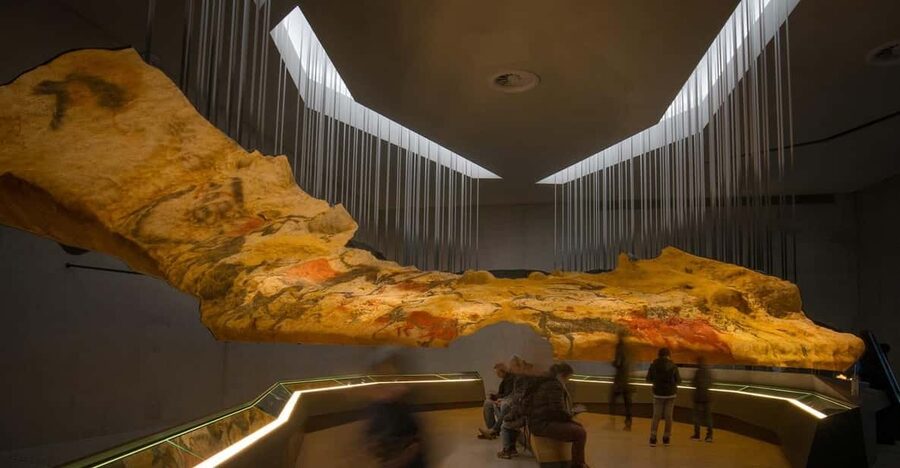
- Lascaux IV uses a full-scale replica: It recreates the original cave’s shape, relief, atmosphere, and famous painted animals while protecting the fragile original.
- Rouffignac adds authenticity: You visit a genuine cave, often by a small electric train, and see engravings and animal outlines.
- Les Eyzies puts Cro-Magnon into context: The National Prehistory Museum holds an enormous collection and sits near the site where five Cro-Magnon skeletons were found in 1868.
- La Roque Saint-Christophe involves stairs: This cliffside troglodyte site is fascinating, but it is not suitable for wheelchair users or people with mobility problems.
- Guides make the day work: Anne, Benoit, Marion, Florence, Martin, Lena, and others have led this route, with strong English and useful local knowledge.
- Prepare for cave temperatures: Bring a warm jacket, since the caves are about 14°C, or 57°F, even on a hot summer day.
Why this Dordogne prehistory day works
Dordogne is one of the best places in Europe to see how early modern humans lived, worked, and made art. The appeal is not just a collection of old objects. You move through several kinds of evidence: museum pieces, an actual cave, a careful modern reconstruction, and cliff dwellings shaped by people over thousands of years.
That variety keeps the day from becoming a string of similar cave visits. The museum explains the people and tools. Rouffignac gives you the feeling of entering a genuine underground site. Lascaux IV shows the most famous paintings in a setting designed to reproduce the original. La Roque Saint-Christophe brings prehistoric shelter and later human engineering into the open air.
The tour begins at the Place Pasteur bus stop near La Maison Secrète in Sarlat-la-Canéda. You travel in a small van with an English-speaking driver-guide, usually no more than eight participants. That size matters here. The roads are narrow in places, the attractions run on timed admissions, and a small group gives you a better chance to hear the guide during the drive.
The day lasts about nine hours, with roughly 30 minutes of driving at the beginning and end. The exact order can change because Lascaux IV assigns specific entry times. I would treat the schedule as a framework rather than a promise that every stop will happen in the printed order.
Full-day trips around France:
- Full-day Saint-Emilion: Village, Undergrounds and Châteaux
★ 4.7 · 41 reviews - Ninh Binh Full-Day Tour from Hanoi to Hoa Lu, Tam Coc & Mua Cave Via Boat & Bike
★ 5.0 · 4,384 reviews - Full Day Cappadocia Tour( Red Tour + Underground City )
★ 5.0 · 1,862 reviews
Les Eyzies and the National Prehistory Museum
The first major stop is Les Eyzies-de-Tayac-Sireuil, a village closely linked with the study of early humans. Five Cro-Magnon skeletons were found here in 1868, helping give the area its special place in prehistoric research.
The National Prehistory Museum opened in 2004 and holds the largest collection of prehistoric artifacts in the world. You receive a guided visit rather than simply being dropped at the door, which is important. A museum of this size could easily become a tiring parade of stone tools, bones, and display cases without a clear explanation.
Your guide helps set up what you are about to see in the caves. The focus is not only on the artwork. You also learn about the people who made it, the materials available to them, and the broad changes in human development that shaped life in the Dordogne.
Guides such as Florence, Benoit, Marion, Anne, and Lena have been praised for explaining complex subjects in clear English without turning the day into a lecture. That personal interpretation is one of the main reasons to choose the guided option. During the drive, the guide can also point out local features and explain how the sites fit together.
The drawback is time. The museum deserves much longer than the portion allowed on a full-day cave itinerary. If you are especially interested in archaeology, you may wish you had a free morning here. One past participant would have preferred less museum time and more time at outdoor sites, so the balance will not suit everyone.
Still, I think the museum earns its place. Without it, the paintings can seem like beautiful but isolated images. Here, you get the tools, fossils, and broader evidence that help make those images part of a human story.
Rouffignac and the value of entering a real cave
Rouffignac offers the authentic underground experience. Unlike Lascaux IV, this is not a complete modern reproduction. The cave contains prehistoric engravings and drawings, including outlines of animals associated with the Ice Age.
The visit is often made by a small electric train, an appealing change from a long walk through a dark passage. It also lets you cover more of the cave without turning the day into a strenuous hike. The train ride is part of the character of the visit, but the exact operation and guide language can vary.
This is where you need to pay close attention to the language arrangements. The tour is conducted in English overall, but cave tours can be assigned in another language. One past English-speaking participant found a German-only cave presentation frustrating, even though a short English tablet explanation was available.
That is not a reason to reject the day, but it is a real limitation. Ask your guide for the clearest instructions before entering and stay near the cave guide when possible. Your driver-guide will explain the site before and after the cave visit, which helps fill in gaps if the live presentation is not in English.
Rouffignac may appeal more to you than Lascaux IV if authenticity matters most. You are in a genuine prehistoric setting, with the irregularity and age that a reconstruction cannot quite reproduce. The art is different from the celebrated paintings at Lascaux, too, so the comparison is worthwhile.
The visit also shows why access to original decorated caves is restricted. These places are fragile. Temperature, moisture, and human breath can affect them. Seeing a real cave here, then visiting a reproduction at Lascaux, gives you a practical lesson in preservation rather than just a policy explanation.
Lascaux IV and the art of making a replica
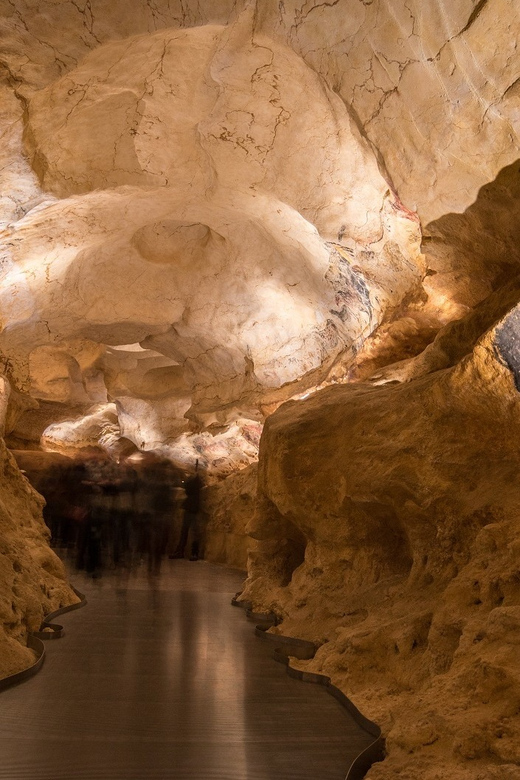
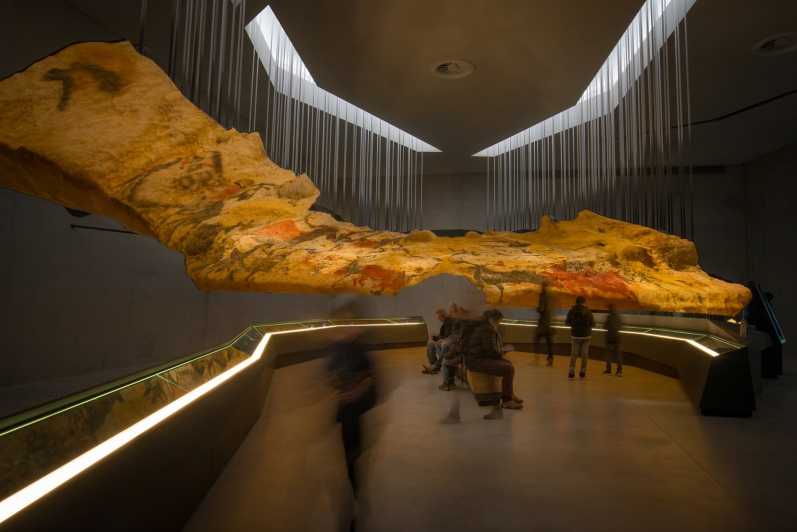
Lascaux IV is the centerpiece for many people. The original Lascaux cave is closed to ordinary public visits, so this purpose-built complex recreates the cave and its artwork for modern eyes.
Calling it a replica does not quite describe the effort involved. A reinforced concrete shell was made with shipbuilding methods, and the cave’s relief was reproduced down to very small details. The paintings were recreated using natural pigments and methods intended to match the originals from about 17,000 years ago.
The result is more than a gallery of copied paintings. You move through a built environment designed to suggest the shape, scale, and atmosphere of the original. The building itself is part of the experience, and the technology behind it is worth noticing.
Skip-the-line access is especially useful here because Lascaux IV operates with timed entries. You are not left to gamble on finding a ticket at the right moment. The guide organizes the day around the reserved slot, although the other visits may shift to accommodate it.
English-language visits inside Lascaux IV are limited. Most scheduled presentations are in French, and simultaneous translation inside the cave is not permitted. Your English-speaking guide will explain the cave before and after your timed visit, so you still have context, but you should not book this expecting every word inside the reproduction to be delivered in English.
For some people, the replica will feel less moving than an authentic cave. That reaction is fair. Rouffignac has the rough authority of the original; Lascaux IV has precision, access, and clarity. I would not treat them as competing visits. They answer different questions.
Rouffignac shows what it means to enter an actual prehistoric cave. Lascaux IV shows how a famous, fragile cave can be shared without exposing the original to thousands of visitors. Seeing both makes the distinction useful rather than disappointing.
The cave temperature is about 14°C, or 57°F. Bring a jacket even if Sarlat is hot and sunny. Comfortable shoes are also important, since the day includes walking, museum floors, cave access, and stairs at La Roque Saint-Christophe.
More cave tours around France:
- Paris: Les Caves du Louvre Guided Tour with Wine Tastings
★ 4.7 · 932 reviews - From Geneva: Chamonix, Mont Blanc & Ice Cave Guided Day Tour
★ 4.8 · 572 reviews - Amboise: Caves Ambacia Visit and Wine Tasting
★ 4.7 · 496 reviews - Dijon: La Cave du Palais Burgundy Wine Tasting Experience
★ 4.8 · 400 reviews
La Roque Saint-Christophe on the Vézère cliffs
La Roque Saint-Christophe adds a striking outdoor stop to a day otherwise centered on museums and caves. It is a sheer limestone cliff that has been inhabited since Paleolithic times, with shelters and built features adapted to the rock face.
The site helps you picture how people used the Dordogne’s natural formations for protection and settlement. The guide explains prehistoric shelters as well as later engineering, so the visit is not limited to one period.
You should expect stairs. This is not a flat viewpoint reached by a short paved path. The site is unsuitable for wheelchair users and is a poor fit if climbing is difficult. Wear shoes with a firm grip and keep some energy in reserve, since it may come late in a full day.
I like this stop because it changes your physical relationship with the region. The cave paintings are underground and enclosed. La Roque Saint-Christophe opens the story onto the cliffs above the river, showing how the same limestone country shaped daily life above ground.
The itinerary information places this visit in the Peyzac-le-Moustier area, while the timing and order may shift around Lascaux’s entry slot. Do not worry if your route runs in a different sequence. The important point is that the day combines the cliffside site with the museum and two very different cave experiences.
Lunch, driving, and the shape of the day
You receive free time for lunch, generally around two and a half hours in the middle portion of the day, although the exact timing can change. Meals and drinks are not included, so budget separately for lunch.
This break is more useful than it may sound. Nine hours of concentrated information can wear you down, and a pause gives you time to eat, walk a little, and talk with the other people in the van. Guides have also recommended local restaurants during the day, which can save you from making a rushed choice.
The van is one of the tour’s practical strengths. It saves you from navigating unfamiliar roads, finding parking, and calculating how long each attraction will take. Several guides have been noted for careful driving, and the vehicle has a microphone so people in the back can hear the commentary.
There is one seating issue to keep in mind. The seats may not rotate during the day, and one participant found being stuck in the last row less enjoyable. If you care about a forward seat, arrive early and ask politely. The group is small, but that does not necessarily mean everyone changes places.
The drive itself is part of the instruction. Guides including Lena, Anne, Benoit, Marion, and Florence have added comments about local customs, legends, villages, food, and the surrounding countryside. That turns transfer time into useful preparation for the next site.
Price, group size, and overall value
At $265 per person, this is not a cheap outing. The value depends on how much you would otherwise need to arrange yourself.
You are paying for a full day of transport from Sarlat, an English-speaking driver-guide, a group limited to eight, visits to Les Eyzies and the National Prehistory Museum, Rouffignac, Lascaux IV, and La Roque Saint-Christophe, plus help with timed scheduling. Meals and drinks are extra, and you should confirm exactly how the attraction admissions are handled when booking, since the conditions distinguish the named visits from other monuments and attractions.
For a couple or family without a car, the price can be sensible. Reproducing the same day requires transportation, careful planning, timed cave reservations, and enough confidence to handle schedule changes. You also lose the guide’s background information during the drives.
If you already have a rental car and prefer a slow pace, the tour may feel expensive and crowded with activities. You could spend longer at the museum or choose one cave and add a village or outdoor site. This tour is designed for breadth, not a leisurely single-site visit.
The 91 percent perfect score for transport fits the main practical advantage: the van is comfortable, the group is small, and the guide handles the road. Just remember that comfort does not remove the long-day factor. You will be out for nine hours and moving through several sites.
Free cancellation up to 24 hours before departure and reserve-now, pay-later booking add flexibility. The tour requires at least two adults to operate, is not available in August, and departs at 8:30 a.m. in July rather than 9 a.m. It runs in rain or shine.
Who should book this prehistory tour
I would choose this day if you want a strong first introduction to Dordogne prehistory and do not want to organize several timed admissions yourself. It suits adults, older children, history fans, art lovers, and anyone who wants a guide to explain what the paintings mean rather than simply point them out.
It is also a good choice for people staying in Sarlat without a car. The route is spread across the region, and the guide’s local knowledge adds value between the major stops.
Families should note that children under four cannot join. Child ages must be given at booking so an appropriate car seat can be supplied. The day is not suitable for wheelchair users, and La Roque Saint-Christophe is not recommended for anyone with mobility issues.
The main question is whether you prefer authenticity or access. If you want only original cave art, Lascaux IV may disappoint you because it is a reproduction. If you want to see Lascaux while protecting the original, then the replica is precisely the point.
Should you book it?
Book this tour if you want to connect the Dordogne’s main prehistoric sites in one well-managed day, especially if you lack a car or want an English-speaking guide. The combination of Rouffignac’s real cave, Lascaux IV’s careful reconstruction, Les Eyzies’ museum, and La Roque Saint-Christophe gives you four distinct ways to understand the region.
Skip it if you dislike fixed schedules, stairs, long days, or museum time. Also think twice if an English presentation inside Lascaux IV is essential to you, since French-language sessions are common.
For most visitors with a serious interest in prehistoric art, the tour earns its price through organization and explanation. Bring a jacket, wear good shoes, expect the order to change, and let the day’s variety do the work.
FAQ
Where does the tour begin?
The meeting point is the Place Pasteur bus stop in Sarlat-la-Canéda, near La Maison Secrète.
How long does the experience last?
The tour lasts about nine hours, including travel between Sarlat and the prehistoric sites.
How many people are in the group?
The group is limited to eight participants.
Is the tour conducted in English?
Yes. The driver-guide speaks English, and the activity language is English.
Which prehistoric sites are included?
The day includes Les Eyzies and the National Prehistory Museum, Rouffignac, Lascaux IV, and La Roque Saint-Christophe. The order can change according to the Lascaux IV schedule.
Is Lascaux IV the original cave?
No. Lascaux IV is a detailed reproduction of the original cave and its artwork. The original cave is not the site visited on this tour.
Will the Lascaux IV presentation be in English?
English tours inside Lascaux IV are limited, and most visits are in French. Your guide explains the cave before and after the visit because simultaneous translation inside is not allowed.
Should I bring a jacket?
Yes. The caves are about 14°C, or 57°F, so a warm jacket is strongly recommended.
Is the tour suitable for people with mobility issues?
No. La Roque Saint-Christophe includes stairs and is not suitable for wheelchair users or people who have difficulty climbing.
Can children under four join the tour?
No. Children under four are not permitted. You should provide a child’s age when booking so the correct car seat can be arranged.
Newly added caves around France
- Paris: Small-Group Catacombs Tour with Skip-the-Line Entry★ 4.9 · 110 reviews
- Paris: Catacombs Tour with Restricted Areas★ 4.8 · 64 reviews
- Marseille: Cosquer Cave Ticket & Panier District Audio Tour★ 4.4 · 17 reviews
- Lascaux IV: Full Replica Cave Experience Ticket★ 4.5 · 334 reviews
- Full-day Saint-Emilion: Village, Undergrounds and Châteaux★ 4.7 · 41 reviews
- From Geneva: Chamonix, Mont Blanc & Ice Cave Guided Day Tour★ 4.8 · 572 reviews
- Dijon: La Cave du Palais Burgundy Wine Tasting Experience★ 4.8 · 400 reviews
- From Sagone/Cargèse: Piana Sea Caves & Snorkeling Boat Tour★ 5.0 · 25 reviews
France Cave Tours worth comparing.
Paris: Catacombs Entry & Seine River Cruise with Audio Guide
Read our review →
Paris: Catacombs, Audio Guide, and River Cruise Option
Read our review →
Paris: Catacombs Ticket and Seine River Cruise
Read our review →
From Geneva: Chamonix, Mont Blanc & Ice Cave Guided Day Tour
Read our review →
Dijon: La Cave du Palais Burgundy Wine Tasting Experience
Read our review →
Bonifacio: Lavezzi Islands and Caves Guided Tour
Read our review →Lists this cave tour appears in