
Review · GREECE
Meteora: Sunset Small Size Tour with Monasteries & Caves
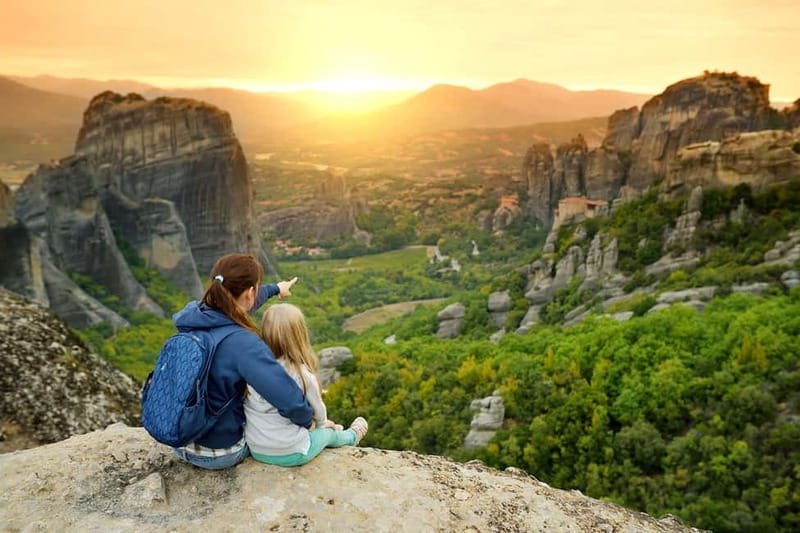
Meteora saves one of its best moods for late afternoon. As the crowds thin, this $35 small-group tour takes you past all six monasteries, into one active monastery, and along paths to the old Bandovas hermit caves. The final sunset, with the rock towers turning gold and gray, gives the whole outing a fitting finish.
I like the local storytelling and the efficient minibus route. Guides such as Lina, Demetris, Jim, Andreas, and Vaggelis have brought geology, monastic life, and local stories into the ride. I also like the mix of famous sights and quieter stops. The main catch is simple: only one monastery is normally open for an interior visit on this late tour, and the sunset depends on clear skies.
Key points to know before you book
- One monastery interior, six monastery views: You get time inside one selected monastery while seeing the exteriors and settings of all six.
- The Bandovas caves add a human story: A short walk leads to old rock shelters used by hermit monks.
- The Byzantine Church of the Virgin Mary is a highlight: It stands in old Kalabaka and was built over an ancient temple dedicated to Apollo.
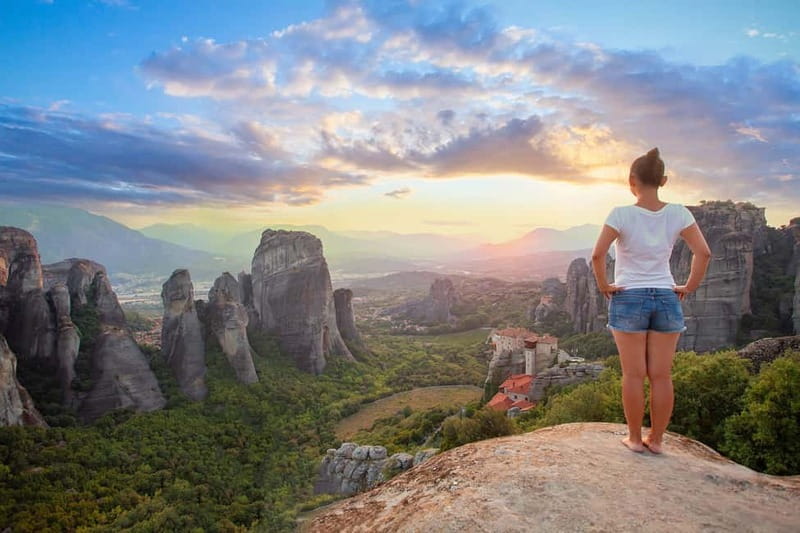
- Sunset is the grand finale: The tour times its last stops for broad views across Meteora.
- Pickup and drop-off are included: Service is available at hotels, villas, guesthouses, Airbnbs, and camping sites in Kalabaka and Kastraki.
- Bring the right clothing: Monasteries require covered shoulders and knees, and women should carry a scarf if possible.
Why late afternoon is the right time for Meteora
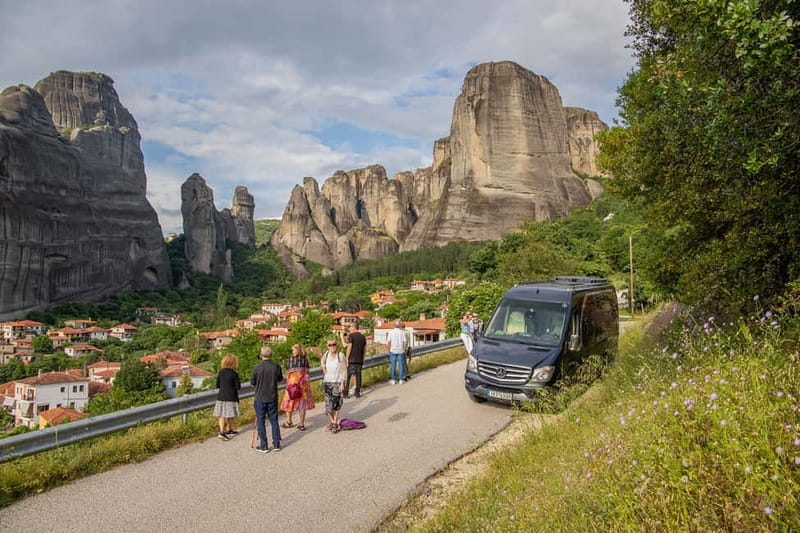
Meteora can feel crowded during the middle of the day, especially around the monasteries. This 270-minute outing begins after many daytime visitors have returned to their hotels, giving you a calmer ride through the rock formations and a softer quality of light for photographs.
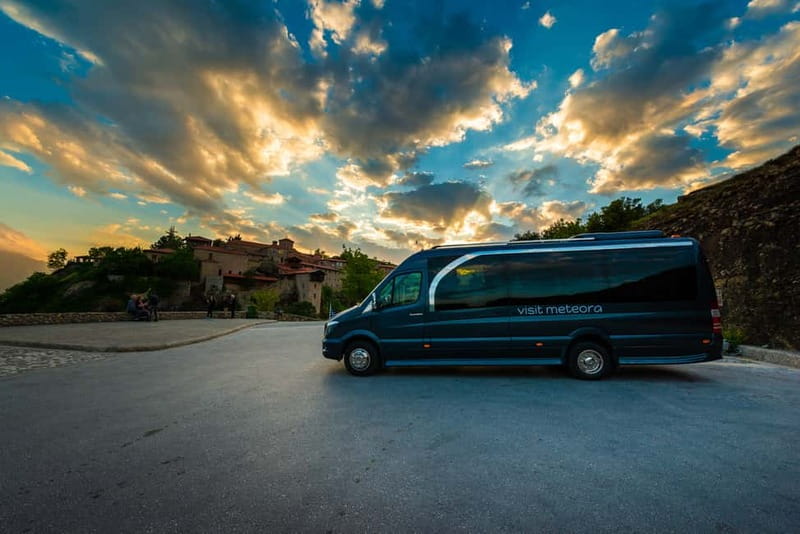
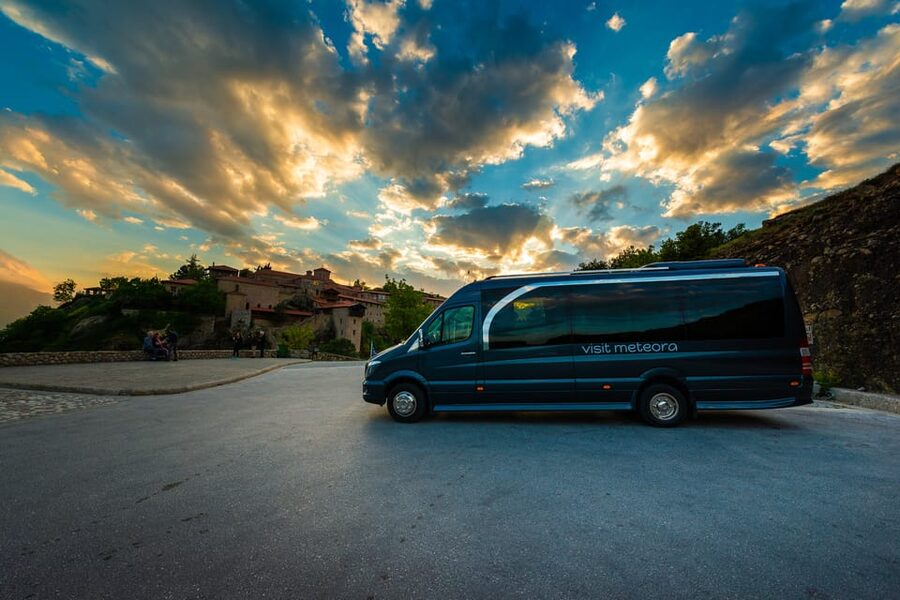
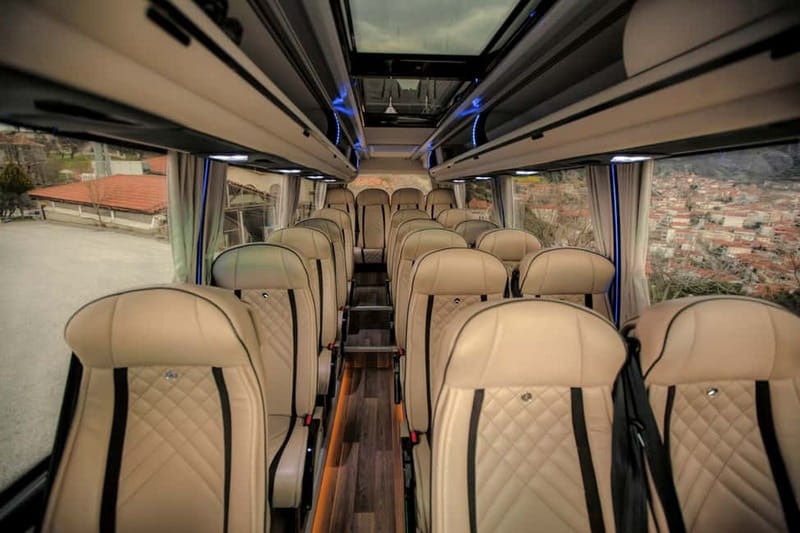
You travel in an air-conditioned minibus, with pickup in Kalabaka or Kastraki. The group is described as small size, though the vehicle can seat around 20 people on some departures. That makes this more personal than a large coach, but it is not necessarily a private tour unless you choose the private-group option.
The guide speaks English, with Greek also listed as an available tour language. A free audio guide covers English, French, Spanish, German, Italian, Portuguese, Polish, Russian, Chinese, Korean, and Japanese at the monasteries and 20 points of interest. Download it before leaving if you need another language. One French-speaking family found that weak internet made it difficult to start the audio guide during the tour.
Evening outings around Greece:
- Meteora: Guided Sunset Tour with Monasteries & Caves Visit
★ 4.7 · 409 reviews - From Lefkimmi: Syvota, Blue Lagoon and Cave Sunset Cruise
★ 4.7 · 332 reviews - Meteora: Sunset Hike to Secret Caves
★ 4.9 · 56 reviews
Kastraki gives you the first wide views
The first stop is Kastraki, a village set beneath Meteora’s towering rocks. You get about 15 minutes for photographs and a short look around. This is a useful opening stop because it lets you see the relationship between the village, the cliffs, and the monasteries above.
Your guide begins setting the scene here. The rocks are not just dramatic scenery. Their shape and height explain why monks seeking solitude chose this place, and why the monasteries were built in such hard-to-reach positions.
The stop is brief, so do not expect a full village visit. Keep your camera ready and wear shoes that are comfortable for uneven ground.
Holy Trinity and St. Stephen show two different sides
The route continues toward Holy Trinity Monastery, one of the most famous sights in Meteora. The stop lasts about 15 minutes and focuses on views, exterior information, and photographs. You do not get a full interior visit here on this schedule.
Next comes St. Stephen Monastery, where you usually have the longest stop, about 45 minutes. This is the selected monastery for interior viewing on many late-afternoon departures. You have time to enter, look at the religious art and buildings, and see how an active monastic site functions today.
The guide or driver does not enter with you. This is a semi-independent visit, so listen carefully to the explanation outside and then explore inside at your own pace. The entry fee is not included and costs €5 per person.
Dress rules are strict. Men can be refused entry if they wear shorts or sleeveless tops. Women may borrow or buy skirts and shawls at the entrance, but I would still pack a scarf and wear trousers or a longer skirt. Comfortable shoes matter here, too, since access can involve steps and walking on uneven surfaces.
St. Nicholas Anapavsa packs a lot into a short stop
St. Nicholas Anapavsa is next, with about 15 minutes for photographs and an outside explanation. The monastery has a compact setting on the rock, making it a good place to understand how builders worked with the cliff rather than simply placing a building on top of it.
This stop is more about the exterior and the setting than a long visit inside. That is typical of the tour. You see all six monasteries, but you should not book this outing expecting interior access to each one.
The value is in the variety. One stop gives you a working monastery visit, another gives you a close exterior view, and others open up the wider scene for photographs.
More cave tours around Greece:
- From Corfu: Day Cruise to Paxos, Antipaxos, & the Blue Caves
★ 4.3 · 4,800 reviews - Athens: Meteora Monasteries Day Trip with Caves and Lunch
★ 4.7 · 4,670 reviews - Zakynthos: Shipwreck Beach with Blue Caves Land & Sea Tour
★ 4.9 · 3,774 reviews - From Corfu Island: Antipaxos & Paxos Blue Caves Boat Cruise
★ 4.7 · 3,690 reviews
Old Kalabaka and the Church of the Virgin Mary
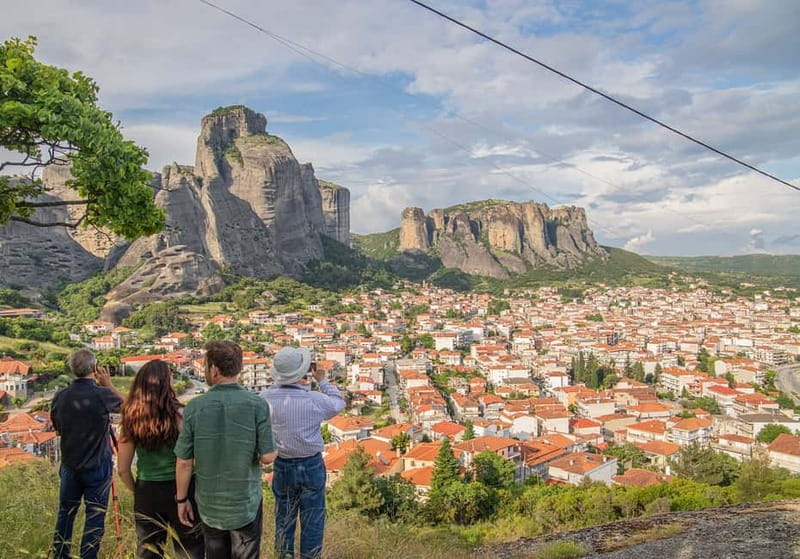
The tour then returns toward Kalabaka for the Byzantine Church of the Virgin Mary. This is one of the more unusual parts of the outing because it moves away from the famous cliff-top monasteries and into the old town.
The church is important for more than its age. It was built over an ancient temple dedicated to Apollo, so the site connects pre-Christian worship with later Byzantine Christianity. Inside, your guide explains the arrangement of the church, the frescoes, and the meaning of the painted images.
You have about 15 minutes here, and the church entry fee is €2. It is not included in the tour price. If you care about art, architecture, or religious history, this may become one of your favorite stops. It also gives the afternoon a welcome change of pace after several mountain viewpoints.
Bandovas reveals the life of the hermits
The Bandovas hermit caves are the tour’s most distinctive stop. A short walk takes you toward old rock shelters where hermit monks lived around two centuries ago. The setting helps you picture an earlier form of monastic life, long before the grand monasteries became the main focus of sightseeing.
You spend about 35 minutes here, enough time for a guided visit and photographs. The path is not presented as a difficult hike, but it is still a walk along natural ground. Shoes with a firm sole are a smart choice, particularly if the rocks are damp.
This stop adds meaning to the monasteries above. The large buildings can look almost unreal from the road. The caves show the harsher, more solitary side of the same religious tradition. You see where individual hermits lived before the better-known monastic communities developed.
Great Meteoron and Varlaam from the road
Great Meteoron, the largest and most famous monastery, comes next. The tour allows about 15 minutes for a guided exterior stop, scenic views, and photographs. You pass by rather than make a full interior visit.
Varlaam receives a similar treatment. Its dramatic position and architecture make it one of the essential views on the route, but the late departure means you generally see it from outside. Your guide fills in the background while the minibus moves between viewpoints.
This arrangement is efficient for a first look at Meteora. You can cover a great deal without spending the whole afternoon climbing monastery steps. The tradeoff is that anyone wanting a close inspection of Great Meteoron or Varlaam will need to return independently during opening hours.
The sunset viewpoint is the payoff
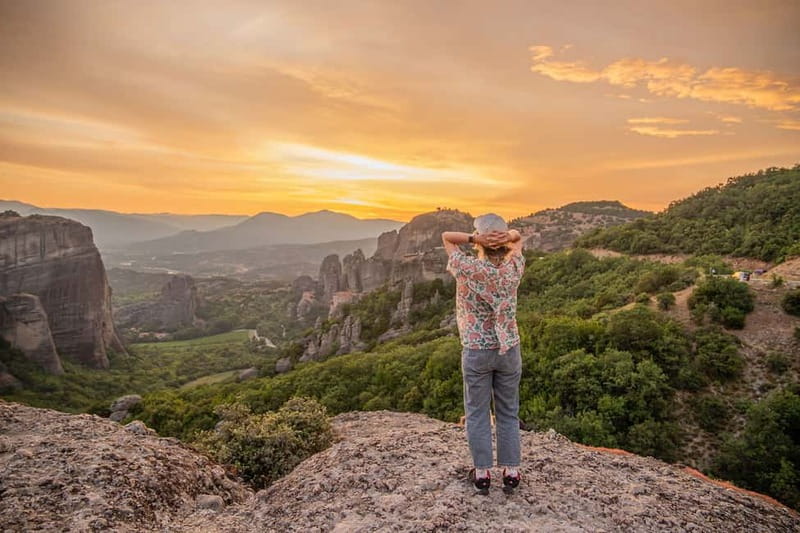
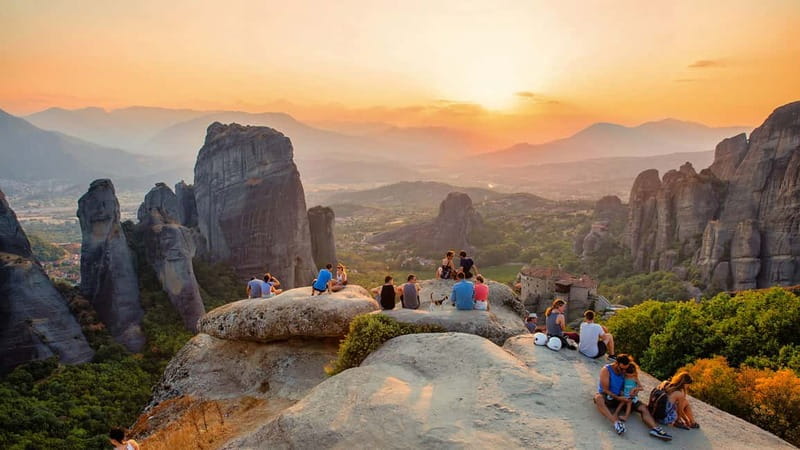
The route includes a dedicated panoramic viewpoint before the final stop near Rousanou. You get around 10 minutes at one viewpoint and about 15 minutes at the sunset area, though the exact timing depends on the season and the day’s light.
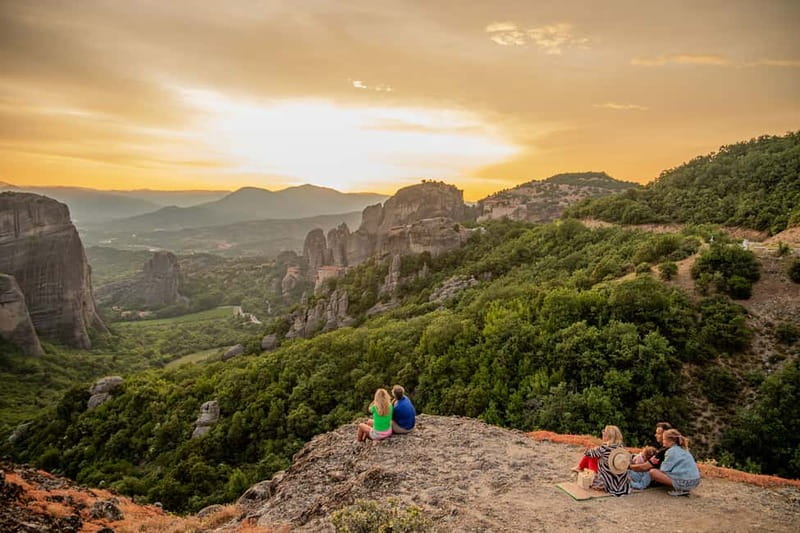
The rocks are most impressive at this hour. The cliffs catch warm color, the monasteries become small shapes against the stone, and the broad view explains why monks chose these heights for retreat. This is the point where the route feels carefully timed rather than simply packed with stops.
Clear weather is never guaranteed. Cloud can block the sun, especially in winter or during unsettled weather. The scenery remains worthwhile, but if a perfect sunset is your main reason for booking, keep your expectations sensible. The tour cannot control the sky.
Rousanou is the final monastery viewpoint, with time for photographs, a short walk, and sunset views. It is a strong ending because you have already learned how the monasteries developed and can now see the entire setting in one view.
The guides add the human details
The strongest part of this outing is often the guide’s storytelling. Local guides such as Jim, Lina, Demetris, Andreas, and Vaggelis have explained the area through personal connections, local stories, archaeology, geology, and monastic traditions.
That matters at Meteora. Without context, the stops can blur into a series of beautiful rocks and old buildings. A good guide explains why the monasteries were placed so high, how the monks lived, and how local people related to the religious communities over time.
The guide stays outside the monasteries, so do not expect a licensed specialist escort inside. Instead, you receive explanations before entering and free time to look around independently. The audio guide is useful here, especially if you want more detail in a language other than English.
What the $35 price really covers
At $35 per person, this is a strong-value introduction to Meteora. You receive hotel pickup and drop-off, transportation, a local English-speaking guide, a bottle of water, a monastery visit, the church visit, the hermit caves, and multiple viewpoints.
You should budget another €7 for the monastery and church entry fees. Food and drinks are not included, and there is no full meal stop. One outing included a short break at a family-run shop and restaurant, but you should not rely on that as a scheduled meal.
The price is especially fair if you have only one afternoon in Kalabaka or Kastraki. A taxi or rental car can take you around, but you would lose the guide’s explanations and would need to plan the monastery hours yourself. If you already have several days in the area and prefer long interior visits, a daytime plan may suit you better.
Free cancellation up to 24 hours before departure and reserve-now, pay-later booking also make this a relatively low-risk choice. Pickup is offered from accommodation and camping sites in both Kalabaka and Kastraki.
Who should choose this tour
I would choose this outing if you want a broad first look at Meteora, prefer not to drive mountain roads, and care about the story behind the scenery. Families can manage it well, with several chances to leave the minibus, stretch, and take photographs. Guides have also handled groups with young children patiently.
It suits photographers, history fans, first-time visitors, and anyone who wants sunset without arranging transport. It is also a good option for people staying in Kalabaka or Kastraki for only one night.
You should think twice if you use a wheelchair, weigh more than 150 kilograms, are bringing a baby under one year, or are over 95. The tour is not suitable for wheelchair users, and the monastery paths and cave walk require mobility.
This is not a full hiking tour, but it is not entirely step-free either. The Bandovas visit and monastery access require comfortable walking shoes.
Practical tips for a smoother afternoon
- Download the audio guide before pickup if you need a non-English language.
- Carry cash for the €5 monastery fee and €2 church fee.
- Pack a scarf and avoid shorts or sleeveless tops.
- Bring a camera, water is supplied, and food is not.
- Leave room in your phone battery for photographs.
- Check the sunset time when booking, since departure hours change with the season.
- If you want to visit more monastery interiors, plan a separate morning visit.
Should you book the Meteora sunset tour?
Book it if you want to see all six monasteries, visit one inside, walk to old hermit caves, and finish with sunset without managing transport yourself. The route is varied, the price is modest, and the local guides add the detail that turns a scenic drive into a meaningful visit.
Skip it only if your priority is entering several monasteries or spending a long time inside each one. For that, return during daytime opening hours. For a late-afternoon overview with strong views, local stories, and an excellent chance at golden light, this is one of the better-value ways to meet Meteora.
FAQ
How long does the Meteora sunset tour last?
The tour lasts 270 minutes, or 4 hours and 30 minutes.
Where can I be picked up?
Pickup is available from hotels, villas, guesthouses, Airbnbs, and camping sites in Kalabaka and Kastraki. Pickup and drop-off locations include Kastraki, Trikala, and Kalabaka.
Do I visit the inside of every monastery?
No. You visit the interior of one selected active monastery and see all six Meteora monasteries from scenic viewpoints or outside locations.
How much are the entrance fees?
The monastery entry fee is €5 per person. The Byzantine Church of the Virgin Mary costs €2 per person. These fees are not included in the tour price.
Is the tour available in languages other than English?
The live tour is guided in English, with Greek also listed as an available language. A free audio guide is available in Spanish, French, German, Italian, Portuguese, Polish, Russian, Chinese, Korean, and Japanese, as well as English.
What should I wear to the monasteries?
Wear comfortable shoes and clothing that covers your shoulders and knees. Men may be refused entry if wearing shorts or sleeveless shirts. Women can borrow or buy skirts and shawls at the monastery entrance, but carrying a scarf is useful.
Newly added caves around Greece
- From Corfu: Paxos, Antipaxos & Blue Caves Day Trip by Boat★ 3.8 · 62 reviews
- Paleokastritsa: Paradise, Yali Beach & Blue Caves Boat Tour★ 4.8 · 293 reviews
- Paleokastritsa: Kasteli, Blue Caves, & Limni Beach Boat Trip★ 4.7 · 165 reviews
- Nidri: Papanikolis Cave, Meganisi, Lakka Beach & Scorpios★ 4.5 · 20 reviews
- Naxos: Cruise to Rina Cave & Ano Koufonissi with BBQ Lunch★ 3.8 · 55 reviews
- Naxos: Rhina Cave and Coastline Sea Kayaking Tour★ 5.0 · 82 reviews
- Naxos: Koufonissia and Rina Cave Boat Trip with BBQ★ 4.7 · 121 reviews
- Naxos: 2 hours Boat Trip from Panermos to Rina’s Cave★ 5.0 · 15 reviews
Greece Cave Tours worth comparing.
From Corfu: Day Cruise to Paxos, Antipaxos, & the Blue Caves
Read our review →
Athens: Meteora Monasteries Day Trip with Caves and Lunch
Read our review →
Zakynthos: Shipwreck Beach with Blue Caves Land & Sea Tour
Read our review →
From Corfu Island: Antipaxos & Paxos Blue Caves Boat Cruise
Read our review →
Athens to Meteora: Monasteries, Caves & Seaside Stopovers
Read our review →
Porto Vromi: Shipwreck, Caves, & White Beach Swimming Cruise
Read our review →
Rhodes: Anthony Quinn, Ladiko and Caves All-Inclusive Cruise
Read our review →
Full-Day Boat Tour of Paxos Antipaxos Blue Caves from Corfu
Read our review →Lists this cave tour appears in