
Review · LESSER POLAND, POLAND
Krakow: Rynek Underground Museum Skip-the-line Guided Tour
Kraków’s Main Square has a second life below your feet. This 90-minute guided tour leads you beneath the Cloth Hall into old streets, trading stalls, burial sites, and archaeological remains that explain how medieval Kraków worked. I like the way it connects the polished square above with the muddy, crowded market town below, and I like that a guide turns a large museum into a clear story rather than a maze of displays.
The multimedia exhibits add sound and movement, while the artifacts keep the visit grounded in real finds. Guides such as Magna and Paulina have earned praise for lively explanations, and Chris for making the material easy to follow. The main drawback is that hearing can be difficult at times, especially in a larger group, and headsets are provided only for groups of 15 or more.
Key points to know before you book
- Nearly 4,000 square meters underground: Walk through old streets, market spaces, archaeological remains, and reconstructed medieval scenes.
- A guide makes the difference: The tour links objects and ruins to trade, religion, burial customs, and daily life.
- 11th-century burials: Reconstructions offer a direct look at how Kraków’s early residents were laid to rest.
- Holograms and films: Touchscreens, projected images, and sound recreate merchants, carts, and the old market.
- One language per group: Choose English, German, French, Italian, Spanish, or Polish when booking.
- Arrive 10 minutes early: Latecomers cannot join after the group leaves, and the maximum group size is 29.
Beneath Kraków’s Main Square
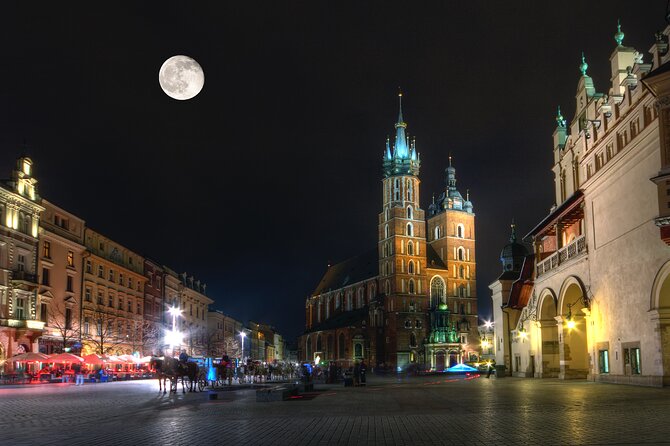
The entrance takes you below one of Europe’s most famous market squares. Above ground, you see St. Mary’s Basilica, the Cloth Hall, and the broad open space used by modern Kraków. Below ground, the museum reveals the layers buried beneath that familiar scene.
This is not a dark tunnel tour with a few dusty stones. The museum covers almost 4,000 square meters, with paths, remnants of buildings, merchant areas, and displays spread through the former market zone. The scale helps you understand that medieval Kraków was not just a collection of grand churches and royal buildings. It was also a working town filled with craftsmen, sellers, buyers, porters, religious pilgrims, and people passing through on business.
Your licensed guide leads the way, which matters here. The museum includes many objects and multimedia stations, and it would be easy to spend your time reading labels without seeing how the pieces fit together. A good guide gives you a thread to follow: how the market grew, how people used it, and how excavations revealed the earlier city.
The meeting point depends on the option you book, so check your confirmation carefully. Arrive at least 10 minutes before the scheduled start. The group leaves on time, and late arrivals cannot join or receive a refund.
Museum visits around the world:
- From Sofia: Rila Monastery and Optional Museum, Cave or Spa
★ 4.6 · 270 reviews - Beatenberg: Beatus Caves Entry Ticket with Museum
★ 4.6 · 253 reviews - Granada: Albaicín, Sacromonte & Museum of Caves Walking Tour
★ 4.9 · 244 reviews
Seeing the medieval market beneath the modern one
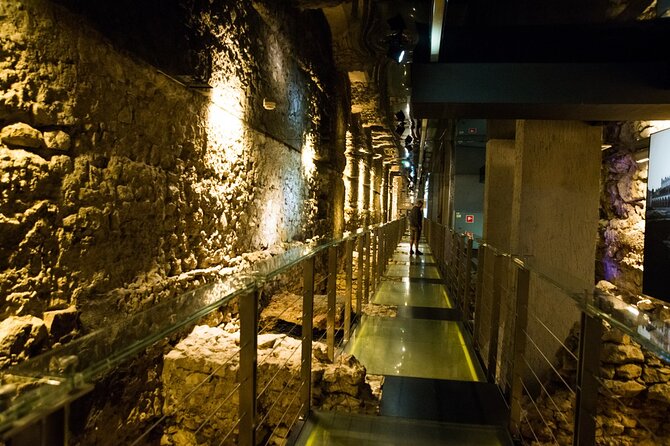
The first major idea is simple but useful: Kraków’s current Main Square was built over earlier layers of streets and buildings. As you move through the underground route, you see traces of those older arrangements and get a better sense of how the city changed across the centuries.
Ancient street lines and fragments of structures help place the old market on a real map. Instead of viewing a single isolated wall, you can consider how streets guided carts, where traders set up, and how people moved through the town. The remains may not look dramatic at first glance, but the guide explains their purpose and ties them to the square above.
This is where the tour is strongest. A stone fragment can feel ordinary when viewed alone. Put it beside an old coin, a piece of jewelry, or the remains of a building, and it begins to show the city as a place of work and exchange. The museum presents Kraków as a trade center connected to a wider part of Central Europe.
The displays also show change over time. Kraków did not appear fully formed. Streets shifted, structures were rebuilt, and the market adapted to new needs. The guide brings out those changes without asking you to memorize a long list of dates.
Merchant stalls, carts, and the business of medieval Kraków
The museum’s merchant areas are among its most useful stops for anyone who wants to understand daily life. Grand architecture often tells you about rulers and religious institutions. Market remains tell you about ordinary work.
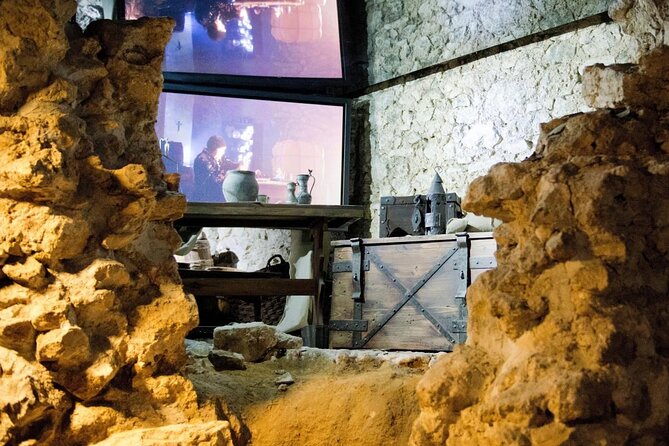
You learn how craftsmen, merchants, and visitors used the square. The multimedia effects recreate calls from sellers and the creak of carts, giving the market a human scale. Touchscreens, films, and holograms help show how the space may have felt when goods were being moved and traded.
I appreciate this blend of evidence and interpretation. The physical remains provide the foundation, while the digital material helps you picture activity that no longer exists. It is not the same as walking through a preserved medieval street, so visitors who prefer untouched archaeology may find some of the effects a little theatrical. Still, the installations make the subject easier to grasp, especially if you are seeing medieval urban life for the first time.
The guide also gives the market a social context. Commerce was not separate from religion, travel, or local politics. People came to buy and sell, but they also passed through on journeys, attended religious events, and dealt with the rules of a changing city. That wider view makes the museum more useful than a simple collection of objects.
The burials and what archaeology can reveal
The reconstructions of 11th-century burials are one of the more striking parts of the visit. They shift the focus from trade and public life to the people who lived in Kraków before the city took its later form.
Burial evidence can reveal more than names and dates. It can show how people were treated after death, how religious customs shaped burial, and what archaeologists can learn from remains found beneath a major urban site. Your guide explains the setting and helps place these discoveries within the earlier history of Kraków.
This part may feel more serious than the market displays, and rightly so. It is not a quick photo stop. Take a moment to look at the reconstruction and listen to the explanation. The museum uses the burials to remind you that the square was once part of a living community, not merely a commercial stage.
If you are visiting with children, the content may call for a little preparation. The museum includes archaeological burials and serious historical subjects, and the guide sets them within a factual story rather than treating them as a novelty.
Skip-the-line tickets around the world:
- Cappadocia: Underground Cities Skip-the-Line Tour with Lunch
★ 4.6 · 142 reviews - From Málaga: Skip-the-Line Nerja Cave and Frigiliana
★ 4.2 · 28 reviews - From Granada: Skip-the-Line Nerja Cave and Frigiliana
★ 4.9 · 22 reviews - Skip the Line Chichen Itza Private Tour, Sacred Cenote & Lunch
★ 5.0 · 1,089 reviews
Artifacts that make the old city personal
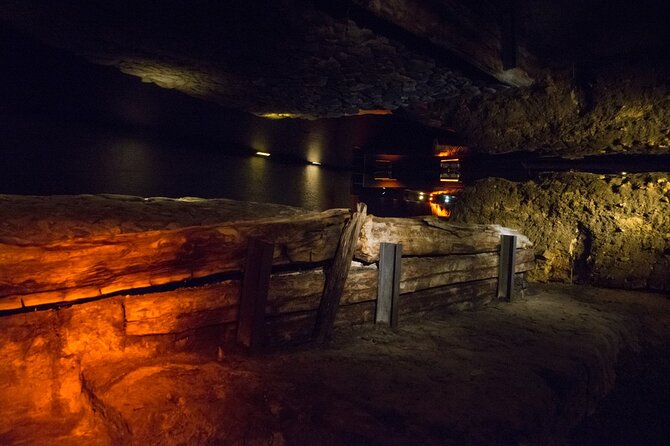
Small objects often carry the most immediate force. Old coins, jewelry, tools, and other finds show what people handled, valued, lost, or carried through the city. They are modest compared with Kraków’s churches, but they can say more about daily life.
A coin points to trade and currency. Jewelry suggests personal identity, status, or family memory. Tools connect the market to skilled work. Together, these objects help you picture the people behind the city’s buildings.
The museum also preserves remains of houses and walls from the Middle Ages. The combination works well: large structural fragments show how the city was built, while smaller artifacts show how it was used. I find this balance more satisfying than a museum that focuses only on either architecture or objects.
The guide’s role is especially important in these rooms. Some displays may not be self-explanatory, and a short explanation can make the difference between passing by and understanding why an item matters. Guides praised for their storytelling, including Magna, Paulina, and Chris, appear to bring energy to material that could otherwise feel technical.
Holograms and films: useful help or too much technology?
The Rynek Underground Museum uses holograms, films, touchscreens, and sound effects to rebuild a sense of medieval Kraków. Merchants’ calls and cart wheels help you imagine the noise of the market, while moving images explain how the square changed.
I like these tools when they support the archaeology. They give you a quick visual answer to questions that a wall label might handle poorly: Where did people walk? How might a trading area have worked? What did the square look like before later buildings covered its earlier layers?
The technology also keeps the museum from becoming a silent sequence of ruins. You are not asked to picture every detail from a few stones and a paragraph of text. The exhibits provide a starting point, and the guide fills in the missing context.
Still, the multimedia displays are not the main reason to book the tour. If you prefer a quiet museum made up of original objects, you may find the projections and reconstructions a little busy. The best approach is to treat them as visual aids. The real value comes from seeing how they connect to the streets, burials, walls, and artifacts discovered below the square.
At the end, you may also have the chance to watch a five-part documentary about the history of the region and its changes across the centuries. It can help tie together the material covered underground, especially if you want a broader account rather than only the market story.
Why the guide is worth the extra cost
Admission alone gives you access to the museum, but the guided option adds structure and interpretation. At a price of about $34 per person, I would consider the tour good value if you want to understand Kraków rather than simply collect a few underground photographs.
The guide explains the archaeological evidence in plain terms and answers questions as the route unfolds. Several guides have been singled out for making the visit friendly, clear, and engaging. One guide, Magna, was praised for her enthusiasm, while Paulina was noted for her helpful and interesting explanations. Another guide, Chris, was remembered for making the material easy to follow.
That does not mean every group will have the same guide or the same style. The experience depends partly on who leads your session. The strongest guides turn the museum into a story about people and work. A less effective guide could leave the multimedia displays to do too much of the teaching.
The tour lasts about 1.5 hours, though the stated duration can range from 90 minutes to 2 hours. That is enough time to see the main sections without turning the visit into an all-day history lesson. One visitor found the pace comfortable and the information manageable, which is important in a museum with many objects and themes.
Group size, language, and hearing
Groups can include up to 29 people. That is not tiny, but it is still a controlled size for a guided museum route. Smaller groups may feel more personal, and one especially positive experience came from a small group where the guide could keep the visit relaxed and engaging.
Tours run in one language only. You can choose English, German, French, Italian, Spanish, or Polish when booking. Do not assume a multilingual group will switch between languages during the visit.
Headsets are provided for groups of 15 or more. This is useful in theory, especially in underground rooms where sound may not carry well. However, a smaller group may not receive headsets, and one visitor found the guide difficult to hear at times. If you have hearing concerns, stay close to the guide and confirm how audio will work when you arrive.
The group size and audio details matter more here than they would in a small room with a few paintings. You are moving through a large museum, and much of the tour’s value comes from spoken explanation. Hearing every part of the commentary will improve the visit.
When this tour fits into your Kraków plans
The tour works best early in your Kraków visit, before or soon after you spend time around the Main Square. After seeing the underground remains, the Cloth Hall and St. Mary’s Basilica above ground make more sense as part of a long sequence of rebuilding and change.
It also suits a cold or wet day because the main experience takes place indoors. The precise meeting point varies by booking option, so allow enough time to find the correct departure location near the square.
At 90 minutes to 2 hours, the tour is easy to fit between other central Kraków sights. You should not treat it as a rushed add-on, though. The burials, street remains, artifacts, and films all reward attention, and the guide’s explanations are a key part of the visit.
This is a good choice for history-minded visitors, first-time visitors who want context, and anyone who learns better by listening than by reading long museum panels. It also suits people who enjoy a balance of original archaeology and modern presentation.
You may want to skip it if you strongly dislike multimedia exhibits or prefer to explore entirely at your own pace. The guided format has a set route, and late arrival means losing the booking. It is also less suitable for anyone who needs a very quiet, self-directed museum visit.
Should you book the Rynek Underground tour?
I would book this tour if you want the Main Square to mean more than a pretty photo stop. The archaeological remains, 11th-century burials, market reconstructions, and small artifacts give you a grounded view of Kraków’s early life, while the guide explains how all the pieces fit together.
The $34 price is reasonable for a skip-the-line ticket and a 1.5-hour guided visit, especially when you value clear interpretation. Choose it in a language you understand well, arrive 10 minutes early, and pay attention to the group size and headset arrangement.
Book it for context, not spectacle. The museum’s best moments come when a guide connects a worn wall, an old coin, and a reconstructed street to the people who once worked and lived here. Afterward, the Main Square above will feel less like a finished monument and more like the latest layer of a very old city.
FAQ
How long does the Rynek Underground Museum tour last?
The guided visit lasts about 90 minutes, with the stated activity duration ranging from 90 minutes to 2 hours.
What languages are available?
Tours are available in English, German, French, Italian, Spanish, and Polish. Each group tour operates in one language, which you select when booking.
How large can the group be?
Museum regulations limit each tour to a maximum of 29 participants.
Are headsets provided?
Headsets are provided for groups of 15 or more. Smaller groups may not use them.
How early should I arrive?
Arrive 10 minutes before the tour begins. Once the group has left, latecomers cannot join and their tickets cannot be refunded.
Can I cancel the booking?
You can cancel up to 24 hours before the activity for a full refund. A reserve-now-and-pay-later option is also available.
Newly added caves around the world
- Phuket: Starlight Hong Sea Cave & Glowing Plankton by Kayak★ 4.9 · 145 reviews
- Phuket: Monkey Cave, Water Rafting, Zipline with ATV Option★ 3.7 · 161 reviews
- Phuket: Bamboo Rafting, Monkey Cave, and ATV Option★ 3.5 · 129 reviews
- Phong Nha: Zipline Dark Cave & Paradise Cave Exploration★ 4.9 · 84 reviews
- Phranang Cave Sunset with BBQ dinner & Plankton Tour★ 3.2 · 53 reviews
- Phong Nha/Dong Hoi: Phong Nha Cave and Paradise Cave Tour★ 4.9 · 82 reviews
- Phong Nha: Cave Exploration and Zipline Dark Cave Tour★ 4.7 · 87 reviews
- Phong Nha National Park: Paradise Cave Half-Day Tour★ 5.0 · 23 reviews